Harnessing a Beginners Mindset
- Gemma Jackson
- Jul 29, 2023
- 5 min read

Updated: Jul 30, 2023
Six months ago, I changed my career path. I took on an internal promotion for a product I was already experienced with, and in fact, having been in the business for a number of years, I had earned a reputation as one of our Product SMEs. Sounds great, right? However, despite being an expert in our product, something I wasn't an expert in was being a Product Leader. No amount of existing business context was going to ease this imposter syndrome, which perhaps felt heavier given I was already far more emotionally invested in this product after years of investment than any experienced newcomer would be.
I immediately felt pressure to be an expert in both the product and the role itself and to set the expectation to everyone around me that I am experienced and absolutely capable. While sometimes there is comfort in "fake it till you make it," unfortunately, it turns out that growth doesn't come with comfort. Beyond comfort, there is growth in your truth, and a significant portion of that growth can only come by being a beginner - which we should never be ashamed to be. In fact, harnessing a beginner's mindset was possibly one of the best things I could have done for myself, not only to work through these first-time experiences but also to identify ways to use them to my advantage.
Lowdown on the Lingo
A beginner's mindset is a concept from Zen Buddhism called Shoshin:
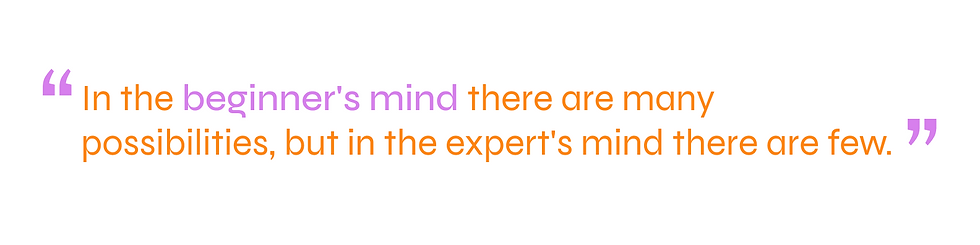
"having an attitude of openness, eagerness, and lack of preconceptions when studying a subject, even when studying at an advanced level, just as a beginner in that subject would.” Conversely, the expert mindset is characterized by deep knowledge, mastery, and a tendency to rely on past experiences and assumptions, while the beginner's mindset embraces openness, curiosity, and a willingness to explore without preconceived notions. As we become more experienced and knowledgeable in our chosen field, there is a risk of slipping into complacency or becoming absorbed in our own biases, whether consciously or not.
A beginners mindset isn't just a once off activity and is something I'm actively working to get better at. However if I look back on the past few months, there are three stand out approaches that I found to have a significant impact (and I'm sure this list will grow).
Tip #1: Welcome Failure
Beginners fail. The first time you tried to walk, you probably fell. You got back up and tried again anyway. When you are learning a new skill, it is almost guaranteed that you won’t succeed on the first try. When we are young or doing something for the first time, we’re often driven by resilience and persistence to accept that failure is okay and do it anyway. With the intention to continue to fail in a progressive, regular cadence until that failure becomes a success. The risk is not in failing, but in letting your failures become uncontrolled. A controlled failure is what becomes a lesson. We add training wheels while we’re learning to ride a bike because we accept we might fall. Look for tools to help you manage the boundaries of failure, but never avoid it.

Embracing the beginner's mindset allows us to approach challenges with a sense of curiosity and a willingness to learn from our mistakes. When setbacks occur, those with a beginner's mindset are less likely to be deterred or disheartened. Instead, they see failure as an opportunity to gain valuable insights and adjust their approach. By reframing failure as a stepping stone rather than a stumbling block, we can take important lessons from these experiences and foster a deep understanding of what went wrong and how to improve. This resilience and adaptability in the face of failure enable you to grow stronger, both intellectually and emotionally. Until eventually, you can ride that bike.
Tip #2 Channel your Curiosity
I hear the saying “Curiosity Killed the Cat,” and feel a little disappointed when the original idiom is shortened. The entire saying is, “Curiosity killed the cat, but satisfaction brought it back.” It’s a metaphor to be wary of the dangers of experimentation, but sometimes those dangers are worth it. The cat survives in the end; it’s got nine lives after all.
Curiosity serves as a catalyst for continuous learning and self-improvement, prompting us to explore, question, and challenge our assumptions. We shouldn't be scared to be curious and should be actively seeking ways to practice curiosity in our day-to-day lives. But just like the cat, we should also be wary not to stray too far or get distracted from what or why we are being curious. I've found being intentional with my learning and my why to be a great way to balance both sides of this.
I often recommend curiosity and playfulness be partnered together. Yes, playfulness. Here I am giving professional advice and recommending play, but the ability to play is an important skill that we need to continually exercise to unlock our full potential for creativity, problem-solving skills, and a deeper understanding of complex subjects. Embracing the spirit of play allows us to experiment fearlessly, find innovative solutions, and view challenges as opportunities rather than roadblocks. Combine the ability to be curious (to think and explore) with the ability to play (to test and experiment), and you are building foundational soft skills within yourself that can translate to any personal or professional circumstance.
Tip #3 Be Present & Aware
As we engage in learning or exploration with undivided attention, with the intention to be present and aware, we become receptive to every detail, nuance, and subtlety. I recently had a colleague ask me, “How are you always on?”, followed by a similar comment, “Whenever I talk to you, I always know you are listening.” Hearing this was no surprise, to be honest, as while it was something I was doing subconsciously and didn't realize it at the time, it was something I know I do actively practice and consciously try to improve.
Conscious listening is a key part of a beginner's mindset, as you are approaching every topic or conversation with the only intent being to learn. You aren't listening with the intention to respond. You aren't listening with the intention to teach. You are listening only to learn. Heightening your awareness of how you listen allows us to absorb information more effectively, comprehend complex concepts more deeply, and make meaningful connections between seemingly unrelated ideas. Approaching every conversation in this way may feel intentional at first, but like every good skill, it comes with practice, and the best way to practice is to build a habit.
Regardless of where you are in your career, adopting a beginner's mindset is a sign of maturity and growth. Focus on improving how you know when to behave like an expert and when to let yourself be a beginner.


Comments